:: GussetBLOG ::
Read it for free, then buy Gusset music
:: Thursday, December 10, 2009 ::
Colo[u]rs of Noise
I came across the term “green noise” recently. White, Pink and Brown(ian) noise have strict mathematical definitions that I am well aware of, but there's a whole spectrum of other definitions out there, some more flexible than others. The wikipedia page is worth a read.:: Sunday, March 15, 2009 ::
For example:
- Blue noise seems to be a term used in graphics dithering,
- A-weighted pink noise becomes Grey noise.
- Bands of zero energy are centered about the frequencies of musical notes in whatever scale is of interest. Since all in-tune musical notes are eliminated, the remaining spectrum could be said to consist of sour, citrus, or "Orange" notes.
- "Green noise is supposedly the background noise of the world. A really long term power spectrum averaged over several outdoor sites. Rather like pink noise with a hump added around 500 Hz."
I want to hear me some orange noise.
This green noise definition is interesting. I would have expected it to more closely resemble traffic noise (see fig below), but maybe that's because I live in a city. I’m going to look into this more as I survey noise levels all over the place anyway.
Normalized road traffic noise spectrum figure, from BS8233:1999
:: Dan 10.12.09 [Arc] [0 comments]::
...


Ray and Charles Eames
Charles and Ray Eames: A Communication Primer:: Tuesday, December 02, 2008 ::
[via smashing telly]
"The Eames’ showed that films could be approached as a design exercise and as such were the forerunners to much of today’s information design, which has had a resurgence as a result of the Web. Their best known piece is Powers of Ten [below], but this is another little beauty.
"The film is nicely self-referential since it deals with Shannon’s information theory. However, the astounding thing is that the Eames’ were savvy about Shannon’s groundbreaking work which was published only 5 years before. To put this in context, its as if Frank Lloyd Wright had written a book about Einstein’s Special Relativity in 1910, when it wasn’t fully endorsed by the physics community."
Powers Of 10Labels: Art, Communication, Design, Film, Maths, Physics
:: Dan 15.3.09 [Arc] [0 comments]
...
Thinking Outside the Cube
César A Hidalgo - Thinking outside the cube on physicsworld.com:: Friday, October 24, 2008 ::
"The discovery that many complex systems are actually well structured networks has not only changed the landscape of physics, but also how we visualize patterns in science."
See some of César's visualisations on his own website.
[large]Labels: Art, Maths, Physics, science, Visuals
:: Dan 2.12.08 [Arc] [0 comments]
...

Fractal Expression
:: Sunday, August 03, 2008 ::
flikr2846
Originally uploaded by flikr.
Image made by flickr user flikr using agony, which he wrote and is available for free download (although it's not open source)
Physics World: Did a Chinese calligrapher use ‘fractal expression’?
In the scientific world, fractals were first identified in the mid-1970s by the mathematican Benoît Mandelbrot.
However, it’s possible that artists and artisans have long been using the fragmented shapes in their work.
In 1999, two Australian physicists famously showed that the “paint-drip” canvasses of Jackson Pollock could be dated by computing their fractal dimension — which tended to increase as Pollock matured as an artist.
Now, Yuelin Li of Argonne National Lab in the US has posted a paper on the arXiv preprint server claiming that calligraphy done by the “maniac Buddist monk” Huai Su more than 1200 years ago contains fractals. Li analysed a request for “bitter bamboo shoots and tea” written by the monk and found that it can be characterized by two different fractal dimensions.
Li believes that the fractal nature of some artworks “can be attributed to the artist’s pursuit of the hidden order of [the] fractal”.
Also in physics related art, Physics World are trying to pick their favourite cover image from the last 20 years to celebrate their anniversary. You can see the 20 short listed images and vote on the link above.Labels: Art, Flickr, Maths, Physics
:: Dan 24.10.08 [Arc] [0 comments]
...


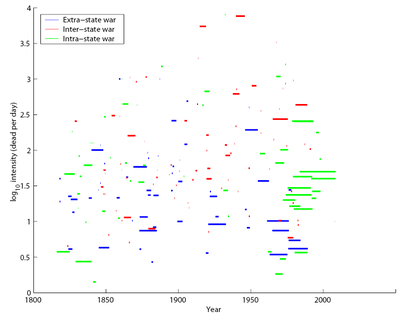
The Graphs of War
Andart: The Graphs of War:: Thursday, June 19, 2008 ::
"Correlates of War attempts to collect data on international relations. During the recent conference on global catastrophic risks I started playing with their data on wars, coming up with the following graphs."
You can't really tell much at this size^ so please follow the link and read through the explanatory text.
[via Arenamontanus' photostream]
:: Dan 3.8.08 [Arc] [0 comments]
...
Google Questions
Crazy Questions at Google Job Interview:: Thursday, March 20, 2008 ::
That made me think! Good fun too.Labels: Google, IT, Logic, Maths
:: Dan 19.6.08 [Arc] [0 comments]
...
The Geometry of Music
:: Saturday, March 15, 2008 ::
Dmitri Tymoczko at Princeton University, where he teaches and has developed a geometric method of representing musical chords.
"When you first hear them, a Gregorian chant, a Debussy prelude and a John Coltrane improvisation might seem to have almost nothing in common--except that they all include chord progressions and something you could plausibly call a melody. But music theorists have long known that there's something else that ties these disparate musical forms together. The composers of these and virtually every other style of Western music over the past millennium tend to draw from a tiny fraction of the set of all possible chords. And their chord progressions tend to be efficient, changing as few notes, by as little as possible, from one chord to the next."
:: Dan 20.3.08 [Arc] [0 comments]
...

Golden Breaks
The Amen Break and the Golden Ratio by Michael S. Schneider (M.Ed. Mathematics):: Tuesday, November 06, 2007 ::
[Via Null Device & others]Labels: Electronic Music, Maths, Samples
:: Dan 15.3.08 [Arc] [0 comments]
...
Numeracy
The Cool Cash [scratchcard] game was taken out of shops yesterday after some players failed to grasp whether or not they had won:: Wednesday, May 30, 2007 ::
The 23-year-old, who said she had left school without a maths GCSE, said: "On one of my cards it said I had to find temperatures lower than -8. The numbers I uncovered were -6 and -7 so I thought I had won, and so did the woman in the shop. But when she scanned the card the machine said I hadn't.
"I phoned Camelot and they fobbed me off with some story that -6 is higher - not lower - than -8 but I'm not having it."Labels: Maths
:: Dan 6.11.07 [Arc] [1 comments]
...
Fractal Food
:: Tuesday, May 15, 2007 ::
I commented on the fractal like qualities of a Romanesco a couple of years ago. Someone else has now taken it a whole stage further:
Fractal Food: Self-Similarity on the Supermarket Shelf by John Walker
[via grom]
:: Dan 30.5.07 [Arc] [0 comments]
...


Flatland
Flatland [full text] by Edwin Abbott:: Monday, April 30, 2007 ::
+ more about it
"Flatland: A Romance of Many Dimensions is a 1884 novella by Edwin Abbott Abbott, still popular among mathematics and computer science students, and considered useful reading for people studying topics such as the concept of other dimensions. As a piece of literature, Flatland is respected for its satire on the social hierarchy of Victorian society."Labels: Literature, Maths
:: Dan 15.5.07 [Arc] [0 comments]
...
Fibonacci Spirals
"The Fibonacci sequence -- in which each successive number is the sum of its two preceding numbers -- regularly crops up in nature. It describes the number of petals around daisies, how the density of branches increases up a tree trunk, and how a pine cone's scales are arranged. Now, having performed "stress engineering" to create Fibonacci-sequence spirals on microstructures grown in the lab, physicists in China think they may have found the reason why the sequence is so ubiquitous -- with a little help from a seemingly unrelated physics problem posed over 100 years ago"
:: Dan 30.4.07 [Arc] [0 comments]
...
